SpaceX IPO: How Employees and Investors Did


Last updated: August 10, 2026.
SpaceX just pulled off the largest IPO in history. It priced at $135 per share on June 11, opened trading June 12 on Nasdaq under the ticker SPCX, and raised about $75 billion at roughly a $1.75 trillion valuation. That made it one of the most valuable companies in the world on day one.
It only got bigger from there. The stock jumped about 19% on its first day to close near $161, kept climbing, and was trading north of $206 within three sessions, a market cap around $2.7 trillion. Days after listing, SpaceX announced a roughly $60 billion acquisition of AI coding company Cursor, and the stock tacked on another 5.6%. It's been a rollercoaster, as of the beginning of August, it tracked all the way down to a low of $104, and jumped back up to $114 by the time the first Lockup release came around.
(Quick note: every share price below reflects post-split values, since SpaceX did a five-for-one split right before listing)
The real story is not the market cap, it's the wealth this created for the people who built the company. Roughly 4,400 current and former employees are set to become millionaires, and about 400 could clear $100 million. As one Bloomberg columnist put it, the SpaceX cafeteria is about to be full of millionaires. A former welder who joined in 2015 with $10,000 in stock now holds about 6,500 shares, worth roughly $880,000 at the IPO price.
So who made what?
Everyone who bought into a SpaceX round is up, and the earlier they got in, the bigger the win. Multiples below are against their first lockup relase closing day price of $114.92, which was on August 6th. (see the current stock price here).
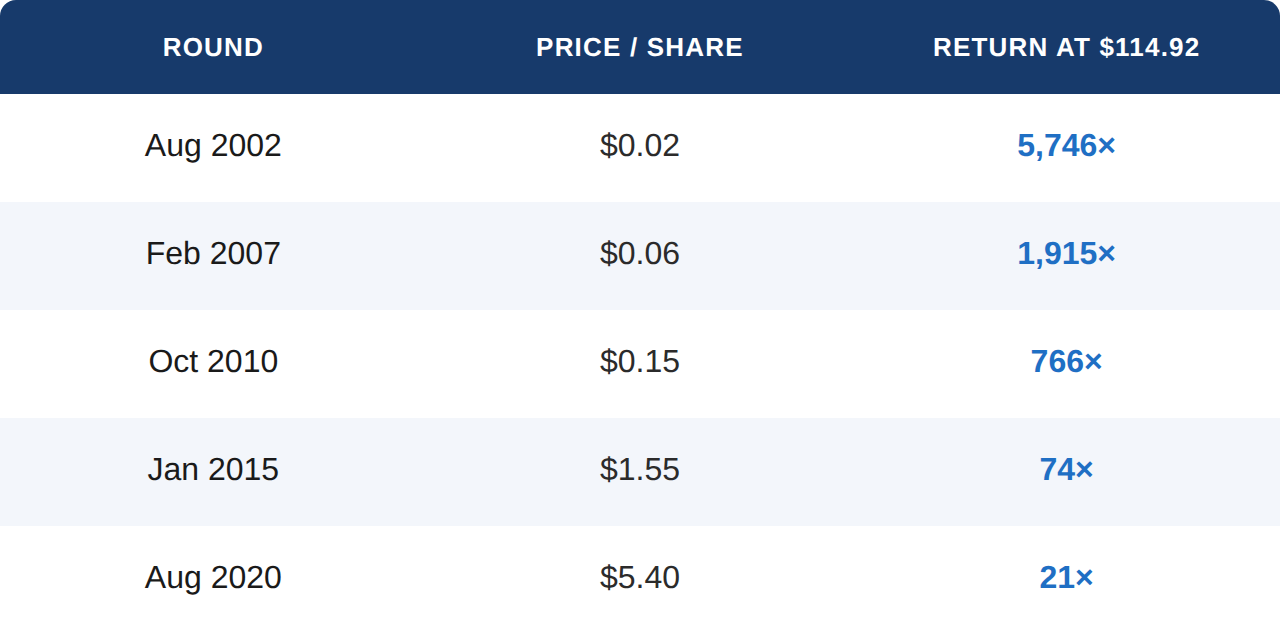
As you can see you can see from the graph above these are some insane returns. SpaceX had many rounds, all the way to Series N (Aug 2020), but to keep it simple we're just showing these five so you can get a picture of how the price increased over time. Even the investors who got the last preferred stock in August 2020 are still making a 21x return. That would be a great return even for a Series Seed investment, let alone Series N.
For employees it came down to one thing: when you got your grant, and the strike price that came with it. SpaceX set option strikes at the fair market value of the stock on the grant date, so early joiners locked in low prices and rode the entire climb.
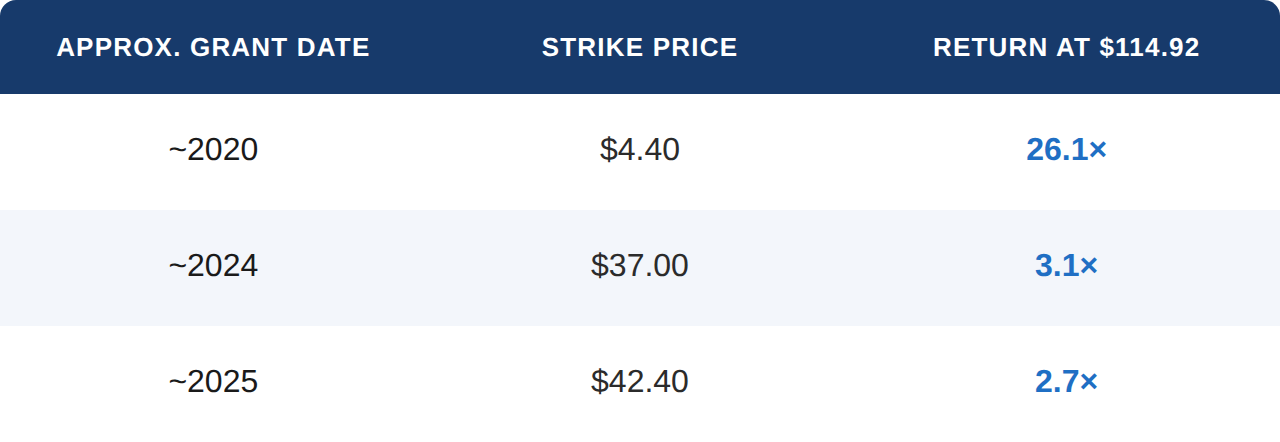
An early-2020s joiner is sitting close to a 26x return. Someone who got a 2025 grant is still looking at a 2.7x. Same stock, completely different outcomes, all driven by entry point. That is the whole case for getting your equity sorted early.
It's also worth noting that the $37 and $42.40 prices, were also Tenders where new investors bought in and employees were able to sell. Employees selling in those tenders with 2020 strike prices would have locked in just below a 10x, but left potential gains on the table assuming the price stays afloat through the end of lockup. Needless to say, across both preferred and common stock, these returns materially outperformed the S&P 500 over the corresponding periods.
A win on paper is not cash in the bank, and SpaceX is not using a simple six-month lockup. The prospectus lays out a staged release for pre-IPO holders:
The founders and certain major investors agreed to a longer 366-day lockup that runs into June 2027.
Liquidity arrives in windows, not all at once, and the earliest tranches depend on the stock holding up. Each release is a decision deadline, not a sell signal. Have your plan ready before the window opens.
Thousands of SpaceX employees now hold a large, concentrated, partially locked position, and many will face exercise costs and tax bills well before they can sell freely. That is exactly the gap we fill. ESO Fund covers the cost of exercising your options and the taxes that come with it, including during an IPO lockup, repaid once your stock is fully liquid. You keep the upside and skip the out-of-pocket risk.
If you are holding options at a company that could be next, the time to plan is before the liquidity window, not during it.
Figures are drawn from SpaceX's S-1 and related SEC filings plus public reporting on early trading. Educational only, not legal, financial, or tax advice.
It was the largest IPO in history. SpaceX priced at $135 per share and raised about $75 billion at roughly a $1.75 trillion valuation, and it began trading on Nasdaq under the ticker SPCX on June 12, 2026.
It came down to grant timing and strike price. Early joiners with low strikes are sitting on roughly 30x to 47x, while employees with 2025 grants are still up about 3x to 5.5x at recent prices. In total, around 4,400 current and former employees are set to become millionaires.
Not all at once. The prospectus sets a staged lockup: up to 20% after the first quarterly earnings report, another 10% if the stock trades at least 30% above the IPO price, then 7% at each of days 70, 90, 105, 120, and 135, a further 28% after the second earnings report, and the rest at the 180-day mark in December 2026. The founder and certain major investors agreed to a 366-day lockup that runs into June 2027.
Yes. ESO Fund can cover the cost of exercising your options and the taxes that come with it, including during an IPO lockup, repaid once your stock is fully liquid. You keep the upside and skip the out-of-pocket risk.
Equity decisions are complex, but you don’t have to navigate them alone. ESO Fund has been helping employees unlock the value of their hard-earned equity for over a decade. Whether you’re exercising, planning for taxes, or looking for liquidity, we’re here to provide clear, non-recourse funding solutions tailored to your situation.
📘 Overview of How We Work
See our 3-step process.
⏰ Option Exercise Funding
Exercise without risking savings.
⭐ Client Reviews
Hear from employees we’ve helped succeed.
🚀 Share Liquidity
Unlock cash while keeping your shares.
📊 AMT Calculator
Estimate tax exposure in minutes.
🤝 RSU Liquidity
Access liquidity from vested RSUs before IPO.
Ready to explore your equity options? Our team is here to walk you through the next steps.
Schedule a Call
This innovative service promotes and enables a healthier relationship between companies and employees. I my opinion it's valuable to employees and great for the overall tech environment and economy. It is good for nobody when employees feel trapped because they can't afford to leave. In less extreme cases exercising can be expensive and somewhat risky and this is simply a good smart hedge and a good square deal. Brilliant!
